|
The Biography of Elvira Ruocco
(by Elvira Ruocco)
Chapter 12
Ms. Elvira Ruocco in her office,
at the beginning of the '80s.
|
The Eighties
(part one)
In front of a market clearly in crisis in Italy and slightly on the mend in the other European markets, Alfa Romeo could manage to stand up to the crisis by succeeding in conquering important spaces where new sale opportunities took place. So that in 1982, Alfa recorded a turnover increase, 5% higher than the previous year, thanks to the “over/mid-size queen”, the Alfetta model in all its versions, which putting to rout all the competitors, ranked at the top of the segment with a share higher than 29%.
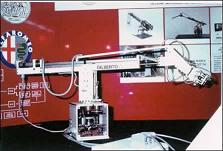 In 1981, the Cad-Cam system for the making of moulds was introduced in Arese, the computer controlled rotary cups for the paint application were adopted in varnishing, and a mechanical arm, dubbed Gilberto, managed by a micro-controller and, from 1983, with voice command, was built with the Politecnico di Milano. In 1983, a sheet laser cutting system was also adopted.
Year 1982 was characterized by the automotive “Plan of Range”, launched in 1979 and which provided for a 2000-billion investment in the five next years, entering the operating phase. In fact, at the beginning of 1983, came into operation in Arese the flexible assembly experimental unit with which the staging of the whole car, except the mechanical parts, was followed by fixed platforms rather than on the traditional assembling line.
On February 25, the new range of sports car was introduced: Sprint, GTV and Spider which stirred up a tremendous interest on Italian and foreign newspapers, on which the recurring adjective used for their presentation was: delicious or delightful.
In the month of June, the new 33 was launched, a new chapter in the Alfa production history. Bound to slip between the Alfasud and the Giulietta, the 33 was presented as a product particularly effective under all the viewpoints that identify the Alfa customer.
Its code (33) referred to a renowned precedent, that of the racing car with two-liter 8V engine prepared in 1965. In order to introduce it to Sale agents and Importers, a big party was organized at the Montecarlo Sporting Club. In twelve days, more than three thousand people took part, and around them an unforgettable kermis took place. Between a course and the following, dancers paraded on the stage performing “historic” dances like the Can-can, Charleston and Rock’n’roll. With the corps de ballet, also the Kessler twins showed off, while light beams lit up the historical cars of the Musem, brought there for the event, until the climax of the gala was reached, with the arrival on the stage of new sedan.
 The first half of the Eighties was the period of the big challenge for the President Ettore Massacesi,
expert of Industrial Relations, whose credit by the IRI top but also by the Alfa executives was falling steep in that period. In the properly automotive field, the Milanese company employed 36.500 subordinates in the Arese, Portello and Pomigliano d’Arco plants. In Pratola Serra, it had just begun the building of the plant which, starting from 1983, would have produced the Arna, the car born from the agreement with the Japanese Nissan.
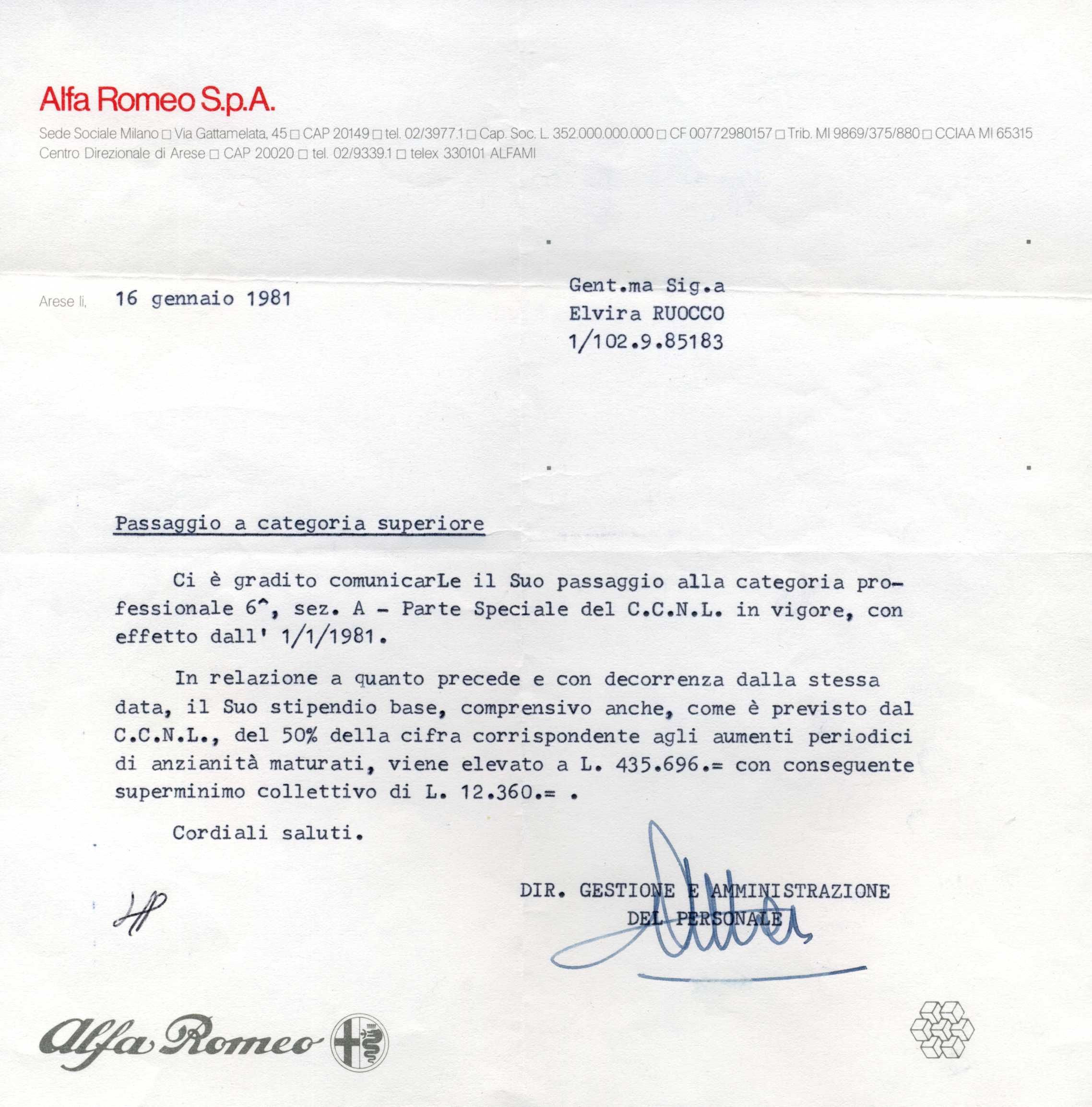
As far as my professional history is concerned, on the January 16, 1981, I achieved after an endless wait the leap to the 6th category and, on November 1st 1983, in the context of the External Relations, I was assigned the charge of the Historic Documentation Centre. In May 1984, a relation was started between Alfa Romeo and the Historic and Economic Public Enterprise Documentation Centre, which yet in 1981 had formulated the proposal for a census and reorganization of the archives of the State-participated companies. A really exacting for me period started for the establishment of the Alfa Romeo Historic Archives.
But I will tell you about this in the next instalment…
Elvira Ruocco
Copyright Information and Credits
All the multimedia materials and the texts present in this page cannot be reproduced in any way without the explicit permit of authors and/or owners of the contents. In particular, this applies with reference to texts and pictures of Ms. Elvira Ruocco and of the Alfa Romeo Historic Archive who explicitly authorized the AlfaSport Club for publication.
Translation by Fabio Grandi
|